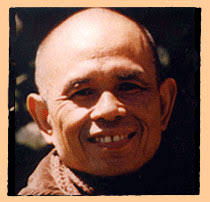


Thich Nhat Hanh and Mindfulness
"The Miracle of Mindfulness"
Thich Nhat Hanh
In the 1960s Thich Nhat Hanh had founded the School of Youth for Social Service in Vietnam; calling it "engaged Buddhism." Young students were trained by the monks to help peasants rebuild their villages, teach their children, set up medical facilities and set up farming cooperatives.
The school refuses to take aside in the war and the students were kidnapped and murdered by the Viet Kong, the army of the Communist North Vietnam. Thich Nhat Hanh was not allowed to move back home , so he wrote letters to encourage the students who he had left behind to be brave; this book is the compilation of those letters.
Thich Nhat Hanh says that when breathing our deep breath in we should be aware or mindful of it; the same mindfulness should be present when we are breathing out. He said that monks use their breath to build up their powers of concentration. He said that feelings and thoughts will arise when we are meditating and we are to acknowledge them. He used this as an example:"Let's say a feeling of sadness arises. say to yourself: "A feeling of sadness has come up in me." Likewise he said when there are no thoughts present, say to yourself:"There are no thoughts present right now.' In mindfulness , he said, we are both the observer of the mind and the mind.
there is a beautiful saying or Koan of this by the Zen masters:"what is the sound of one hand clapping?"It seems to Hanh that the mind experiences itself from within.
Buddha wrote once a "Sutra" of mindfulness. This Sutra describes the mind as being "like a monkey, swinging from the trees of the forest."The monkey mind exists because the mind is not aware of itself. The mind is like a man trying to gain control of the monkey as it travels from tree to tree.
"If the Buddha got Stuck"
by Charlotte Kasl, Ph.D.
In her book Dr. Kasl tells an old Buddhist tale.
A university professor goes to see an old Zen master for advice. The profesor sits down to have tea with the master. The Zen master pours the tea into his cup until it overflows into his lap. Dismayed, the professor looks over at him. He say"A mind that is already full cannot take in anything new."


